Multi-Master

Migrating from MySQL Master-Master Replication to Galera Multi-Master Replication

Introduction

Galera is a synchronous Multi-Master Replication for MySQL. It is therefore in competition with several other MySQL architectures:

Very often they can be easily replaced by Galera’s synchronous Multi-Master Replication for MySQL.

All those products have some advantages and disadvantages. Very often MySQL Master-Master Replication is used in the field because of its simplicity to set-up. But …

Building Galera Replication from Scratch

Introduction

MySQL/Galera synchronous Multi-Master Replication consists of 2 parts:

If you do not want to download the prepared binaries you can build it on you own.
First you have to download the native MySQL sources, then patch it with the Galera wsrep patches and compile it. In a second step you have to build the Galera Plugin.

This is especially useful because in the standard Galera binary tar balls the garbd …

Galera - Synchronous Multi-Master Replication Cluster for MySQL/InnoDB

Galera features

Galera provides the following features:

  • Synchronous replication
  • Active/active multi-master topology
  • Read and write to any cluster node
  • Automatic membership control, failed nodes drop from the cluster
  • Automatic node joining
  • True parallel row level replication
  • Direct client connections
  • Drop-in replacement for native MySQL

Galera benefits

Benefits using Galera Replication:

  • High Availability
  • No slave lag
  • No lost transactions
  • No more data inconsistency
  • Smaller client latencies
  • Read scalability …

Be cautious when using Virtualized System with your Database

A customer rose a support case with a problem on his Master-Master set-up. The 2nd Master claims to have a problem:

master2> SHOW SLAVE STATUS<br>G
                ...
    Master_Log_File: master1-bin.000014
Read_Master_Log_Pos: 97975045
   Slave_IO_Running: No
  Slave_SQL_Running: Yes
Exec_Master_Log_Pos: 97975045
      Last_IO_Errno: 1236
      Last_IO_Error: Got fatal error 1236 from master when reading data from
                     binary log: 'Client requested master to start replication …

MySQL Multi-Master – Single-Slave – Replication (Episode 2)

Introduction

One of the features that make MySQL so great is its easy replication set-up. If you are experienced and know-how to do it, it takes you about 15 minutes to set-up a slave. What you have in the end is a replication from one master to one or several slaves. So you can build a top-down data stream pyramid and spread your data on many slaves.
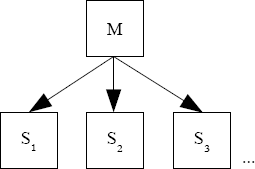
MySQL Replication

From time to time some customers are asking for the other way: Many masters replicating to one slave (which is also called multi-source replication). For …

MySQL Multi-Master - Single-Slave - Replication

MySQL provides its replication for High Availability (HA) and for read Scale-out. Generally it is known that in a MySQL replication you can only replicate from one Master to many slaves. In this paper it is shown how a set-up can look like to replicate from two masters to one slave.

Caution: Handle this information with care!!!

Subscribe to RSS - Multi-Master