Myisam

Query performance comparison between MariaDB ColumnStore and other Storage Engines

Storage Engines like InnoDB, Aria and MyISAM are Row Stores. They store rows one after the other in blocks or even directly in a single file (MyISAM). On the other hand a Column Store like MariaDB ColumnStore stores all the same attributes (columns) of the rows together in chunks.

This is how the table sales_fact looks like:

CREATE TABLE `sales_fact` (
  `product_id` int(11) NOT NULL,
  `time_id` int(11) NOT NULL,
  `customer_id` int(11) NOT NULL,
  `promotion_id` int(11) NOT NULL,
  `store_id` int(11) NOT …

Limiting MySQL tmpdir size

Today a customer gave me the idea of using a separate file as a volume for limiting the MySQL tmpdir size. On some not so well set-up Linux systems the MySQL tmpdir is located under /tmp which is the same mount point as / (root). This can lead to troubles in case the tmpdir is filled up with implicit temporary MyISAM tables which fills up the / (root) directory of the O/S as well.

MySQL itself has no possibility to limit explicitly the total size nor the number of implicit temporary tables. So this can …

Do not trust other peoples benchmarks!

Because they do NOT reflect your problems.

One of our customers upgraded last month from MariaDB 10.2 to MariaDB 10.5. In the same change he also converted all his data warehouse (DWH)/BI tables from MyISAM to Aria. An all this, naturally, without testing. And it miserably failed! And then we were under heavy time pressure to make things working again…

What has changed:

  • MariaDB version: MariaDB optimizer got a lot of changes between these 4 major release series (10.2, 10.3, 10.4 and 10.5)!
  • Storage …

MyISAM locking and who is the evil?

Yes, I know, MyISAM is deprecated and unofficially discontinued by the vendors. But we still have from time to time customers using MyISAM and even evangelize for MyISAM…

And to be honest in some cases MyISAM has even advantages (beside some huge disadvantages) over other Storage Engines (simple file copy, footprint, single-query latency, …). But most of our customers are not aware of these advantages and are using MyISAM just because they did it since ever…

One of the biggest problems …

Flush time is set

If the variable flush_time is set to a non-zero value, all tables are closed (and flushed) every flush_time seconds to disk. This can cause unnecessary and high I/O spikes.

For further information consult MariaDB or MySQL documentation.

Switching from MySQL/MyISAM to Galera Cluster

Switching from MySQL/MyISAM to Galera Cluster requires that all tables (except those from the mysql, information_schema and performance_schema) are using the InnoDB Storage Engine.

For altering the Storage Engine of the tables we wrote a script (alter_engine.pl) long time ago already. Because we have made many of those switches recently we have extended its functionality.

New features

  • Recognizes VIEW’s and does NOT try to alter their Storage Engine (bug).
  • Script is MySQL version aware. Complain if …

MySQL tmpdir on RAM-disk

MySQL temporary tables are created either in memory (as MEMORY tables) or on disk (as MyISAM tables). How many tables went to disk and how many tables went to memory you can find with:

mysql> SHOW GLOBAL STATUS LIKE 'Created_tmp%tables';
+-------------------------+----------+
| Variable_name           | Value    |
+-------------------------+----------+
| Created_tmp_disk_tables | 49094    |
| Created_tmp_tables      | 37842181 |
+-------------------------+----------+

Tables created in memory are …

Change MyISAM tables to InnoDB and handle SELECT COUNT(*) situation

Its a known problem that changing the Storage Engine from MyISAM to InnoDB can cause some problems
[ 1
] if you have queries of this type:

SELECT COUNT(*) from table;

Luckily this query happens rarely and if, the query can be easily omitted or worked around by guesstimating the amount of rows in the table. For example with:

SHOW TABLE STATUS LIKE 'test';

But in some rare cases customer really needs these values for some reasons. To not exhaust the resources of the server with this query which can be fired …

How MySQL behaves with many schemata, tables and partitions

Introduction

Recently a customer claimed that his queries were slow some times and sometimes they were fast.

First idea: Flipping query execution plan caused by InnoDB could be skipped because it affected mainly MyISAM tables.

Second idea: Caching effects by either the file system cache caching MyISAM data or the MyISAM key buffer caching MyISAM indexes were examined: File system cache was huge and MyISAM key buffer was only used up to 25%.

I was a bit puzzled…

Then we checked the table_open_cache …

How good is MySQL INSERT TRIGGER performance

Abstract: In this article we discuss how big is the performance impact of MySQL TRIGGERs compared to application side logging (with INSERT) into a MySQL table.

What was in my mind from the past

A while ago when MySQL released its Stored Language features in v5.0 I have seen a book
[1
] about this topic. In this book was a performance comparison between different implementations of computational tasks, one was done in MySQL Stored Language. The result was, that MySQL Stored Language feature sucks also …

How many warm MyISAM key blocks do you have?

When you are working with MyISAM [ 1 ] tables MySQL provides a feature called the Midpoint Insertion Strategy [ 2 ]. You can enable it with the parameter key_cache_division_limit [ 3 ].

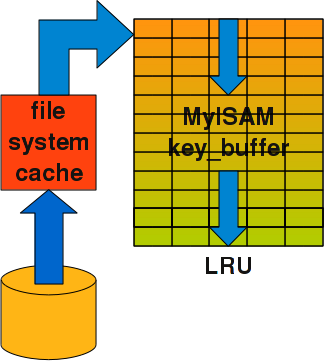
By default, the key cache management system uses a simple LRU [ 4 ] strategy for choosing key cache blocks to be purged:

MyISAM key buffer

When using the Midpoint Insertion Strategy feature, the LRU chain is divided into two parts:

  • the hot sub list

and

  • the warm sub list.

The division point between those two parts is not fixed, but the …

Subscribe to RSS - Myisam